How a smart recyclable plastic bruises to reveal scratches
Scientists have created a crosslinked polyethylene material that changes colour when scratched and can be reprocessed without messy chemical solvents.
Reading level
The full story with proper science words explained.
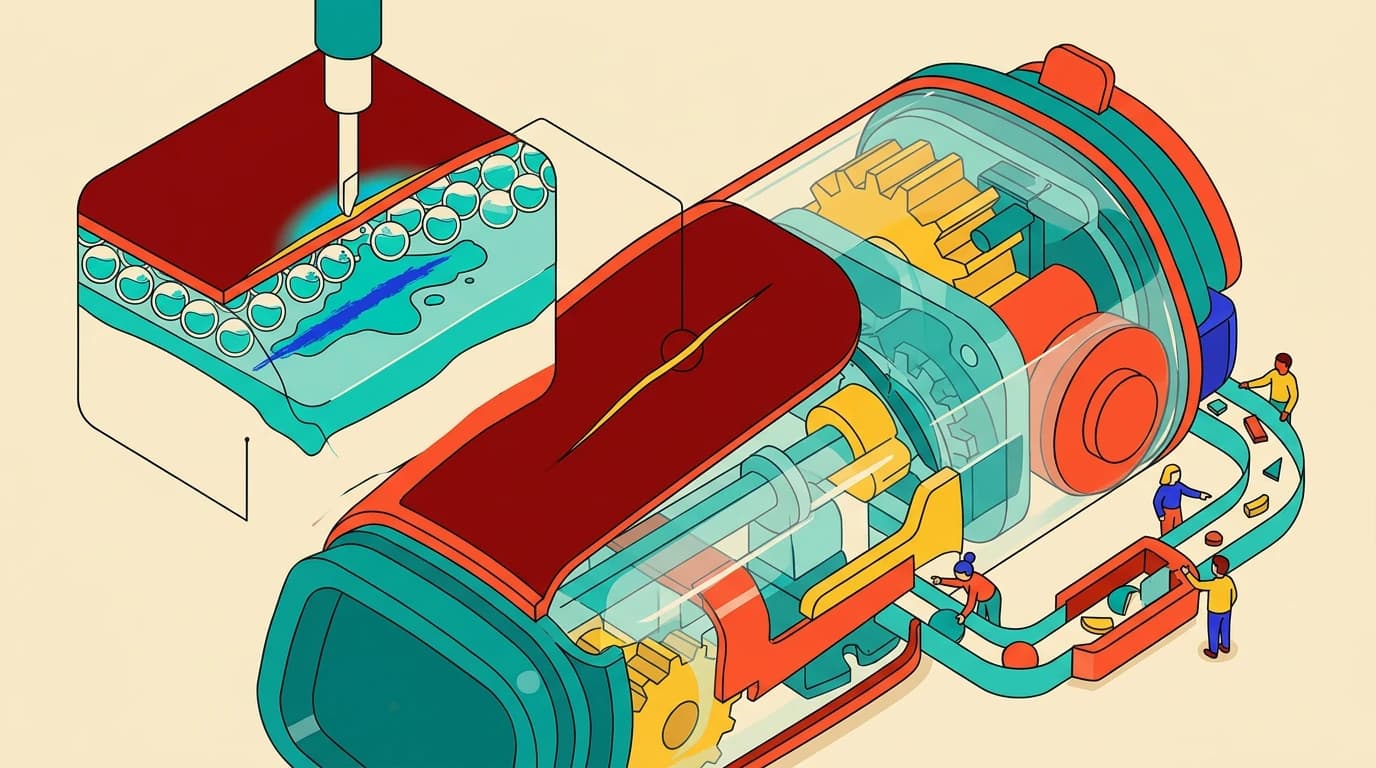
A plastic that shows its bruises
What if a cracked plastic part showed a bright mark before it broke? Tough linked plastics usually hide wear until they snap. Tossing them into a recycling bin is hard because their molecular bonds do not melt. Now, chemists have made a smart recyclable plastic. It shows scratches with a clear colour shift while staying easy to remould.
Molecular bridges that swap seats
The team started with PE-HEMA, a polyethylene copolymer with built-in side handles for joining. Standard plastics glue these long chains in place forever. Instead, the researchers linked the chains with a molecule called naphthopyran. This acts as a dynamic crosslinker, a bridge that breaks and reforms when heated.
These bridges form using silyl ether exchange chemistry, a process where silicon-oxygen bonds swap partner links. The team built the final network using reactive extrusion. This method mixes and heats the solid ingredients with turning screws, so it needs no liquid solvents. Making the precursor molecule also skipped solvents entirely.
When scratched or pressed, the naphthopyran units act as a mechanochromophore, meaning they shift colour under force. The molecules bend into a new shape, creating an optical signal right where the scratch happens. This warns users of hidden damage before the whole part gives way.
Why swappable bonds matter
Most linked plastics become locked solids that cannot melt again. In this material, heat lets the silicon bridges let go and hook back up. Factory tools can melt and reshape the solid plastic without needing harsh liquid solvents. This gives industry a cleaner way to process tough parts that can still warn us when they take damage.
What we still do not know
This work shows that the basic idea works in the lab, but several questions remain open. The study gives no hard numbers on the plastic's strength or its resistance to wear. We also do not know how many times it can be remelted before breaking down, or whether the scratch colour fades over time.
Science words
- PE-HEMA
- A copolymer of polyethylene that provides chemical attachment points along its chain.
- Dynamic crosslinker
- A molecular bridge between polymer chains that can break and reform.
- Naphthopyran
- A molecule that changes its shape and colour under stress.
- Silyl ether exchange chemistry
- A reversible reaction involving silicon-oxygen bonds that swap partners.
- Reactive extrusion
- A continuous, solvent-free method using heat and rotating screws to carry out reactions.
- Mechanochromophore
- A molecule that changes colour when subjected to physical force like stretching or scratching.
Check it yourself
This story is based on a real research paper in RSC Advances by Nicolella, Giovanardi, Rispoli et al. We write with AI help and check it against the paper, but the original is the final word.