How a shape-shifting crystal makes a Raman sensor spot tiny water pollutants
Researchers built a shape-memory crystal that alters its nanoscale shape to boost light signals, detecting trace antibiotics in wastewater down to 471 parts per trillion.
Reading level
The full story with proper science words explained.
A smart memory trick
Finding a drop of drugs in city sewage sounds very hard. Spotting single chemical bits often uses SERS (surface-enhanced Raman scattering). This method boosts faint light bouncing off chemical bonds. Yet common sensors have fixed patterns. Their light traits cannot adapt to pull out the strongest signal.
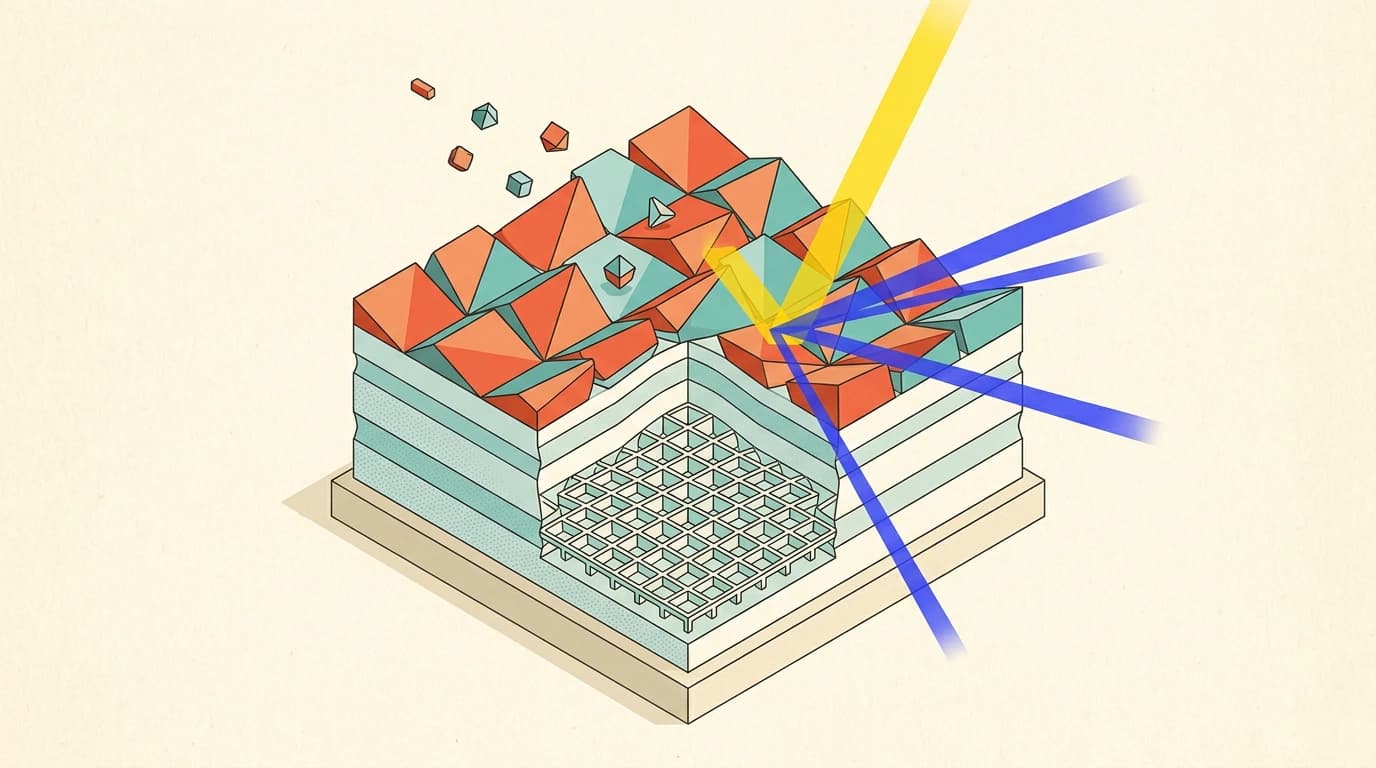
To fix this, scientists built a tunable Raman sensor using a shape-memory polymer. This smart plastic deforms under stress and then springs back to its start shape. That shift changes the spacing of its tiny parts on demand.
Slowing light down
The device pairs a photonic crystal with a plasmonic surface. The crystal steers light, while the metal surface traps light into tiny zones called hotspots. As the plastic shifts, the photonic stopband edge moves relative to the laser beam. This is the boundary where light cannot pass through the crystal. Mechanical touch or liquid drying triggers this shape change back and forth.
When these changes line up, they create a slow-photon effect. This briefly slows down light waves. Slower light interacts more strongly with bits of matter sitting on the surface. Because these factors compete as the shape shifts, signal strength rises and falls unevenly. When fully restored, the crystal gives an 8.1-fold signal boost over a plain plasmonic copolymer base.
Testing dirty water
Next, the team tested real city sewage to see if the tool works outside the lab. The sensor spotted dissolved antibiotic traces down to 471 ppt (parts per trillion). That is like finding less than a single drop in many huge swimming pools.
What we still do not know
This study is an early test, not a final tool. The sensor found antibiotics down to 471 ppt, but the team did not test other water pollutants. We also do not know how many squash cycles the device can survive before its memory wears out.
Science words
- SERS
- Surface-enhanced Raman scattering; a method that magnifies light scattered by chemicals to detect tiny samples.
- Shape-memory polymer
- A smart plastic that can change shape and later return to its original form.
- Photonic crystal
- A repeating microscopic structure that controls how light waves move.
- Plasmonic
- Using waves of electrons in metals to squeeze light into nanoscale spaces.
- Photonic stopband edge
- The border where light shifts from passing through a crystal to being blocked.
- ppt
- Parts per trillion; a unit that measures extremely tiny amounts of a chemical.
Check it yourself
This story is based on a real research paper in ACS Applied Materials & Interfaces by Lin, Ashurov, Liu et al. We write with AI help and check it against the paper, but the original is the final word.