How a missing DNA chunk may help mosquitoes cope with lab heat
After three years in a hot lab, a 5-kb deletion in a clock gene became common in Anopheles stephensi mosquitoes, boosting male mating success and making females more likely to catch malaria parasites.
Reading level
The full story with proper science words explained.
A puzzling heat trick
Picture a city-living insect thriving in hot places where other bugs struggle. How does the mosquito Anopheles stephensi cope with high heat so fast?
To find out, a team raised these malaria-carrying bugs in a hot lab for three years. They tracked how the insects' DNA changed under steady heat. Studying them in a lab lets the team control the heat and spot DNA shifts clearly.
A steady clock in the heat
After three years, a 5-kb deletion—a missing stretch of 5,000 DNA letters—had become common. It sat inside timeless, a circadian clock gene that runs the insect's 24-hour body clock.
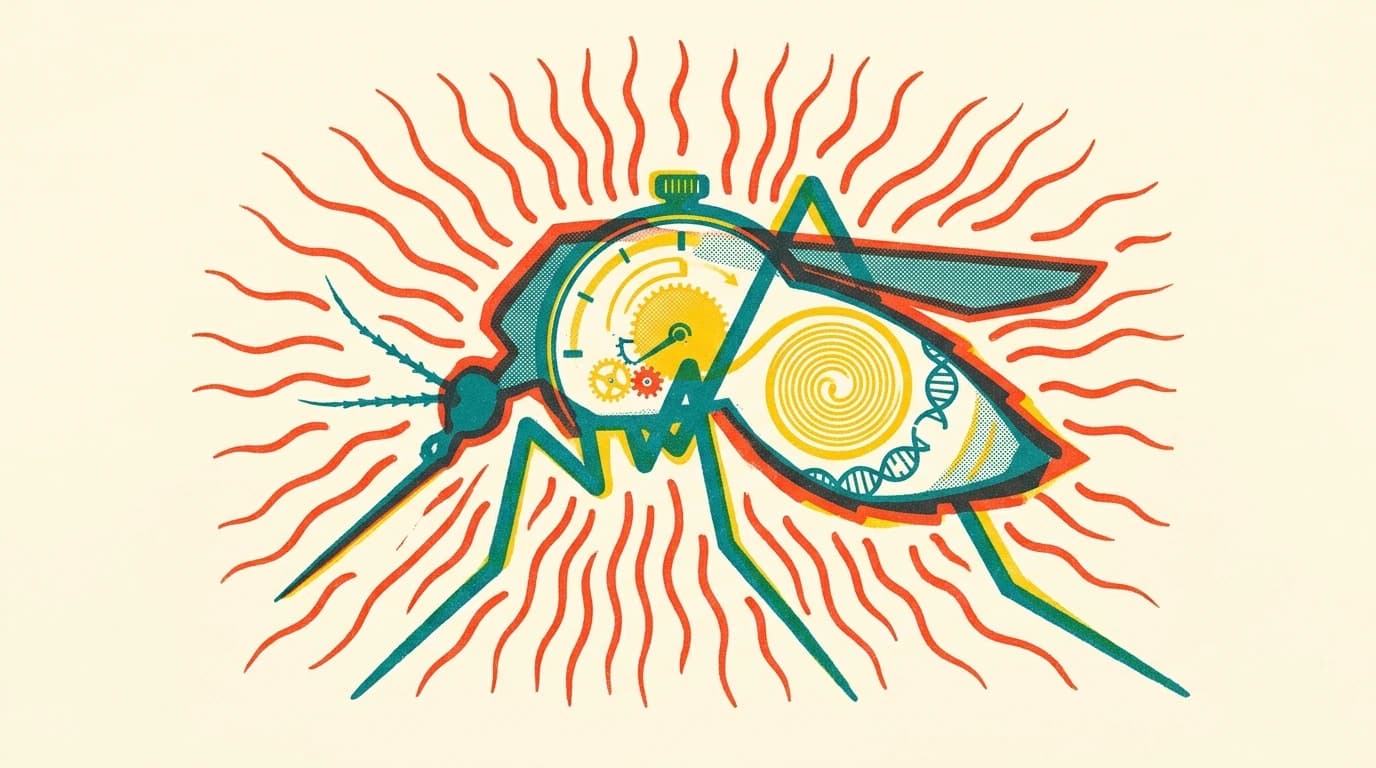
This change worked like a heat-proof watch spring. It kept the body clock ticking on time during a heatwave. Of course, a living bug is more complex than a watch, because this DNA tweak also alters fuel use, scent, and disease risk.
The biggest winners were heterozygous males, meaning they carried one normal gene copy and one missing-piece copy. In the heat, their period clock gene stayed stably active. That gave these one-copy males an edge in winning mates.
That edge was linked to higher levels of three other genes. AKH1 helps release stored fuel for flight. Also, FAR3 and FAR5 boost heptacosane pheromone, a chemical scent that draws in mates.
The hidden cost for malaria
There was a catch for humans, though. One-copy females were more likely to catch Plasmodium, the single-celled parasite that causes malaria.
This raises their potential to spread the disease. Still, these results come from a three-year lab study. They show a process that may drive heat coping, rather than measuring wild spread in African cities.
What we still don't know
Researchers still do not know how widely this missing DNA is spreading in wild Anopheles stephensi across Africa. They also do not know why one-copy females catch malaria parasites more easily, or how bugs with two missing-piece copies fare.
Science words
- 5-kb deletion
- A missing stretch of DNA that is 5,000 base pairs long.
- circadian clock gene
- A gene that helps run an organism's 24-hour body clock.
- heterozygous
- Carrying two different versions of a gene, such as one normal copy and one changed copy.
- heptacosane pheromone
- A chemical scent made by mosquitoes that helps draw in mates.
- Plasmodium
- The single-celled parasite that causes malaria.
Check it yourself
This story is based on a real research paper in Cell by Wang, Sun, Yang et al. We write with AI help and check it against the paper, but the original is the final word.