How a marine diatom virus rewires its host before killing it
An RNA virus alters over a third of a marine diatom's genes and reshapes its fats before the cell bursts.
Reading level
The full story with proper science words explained.
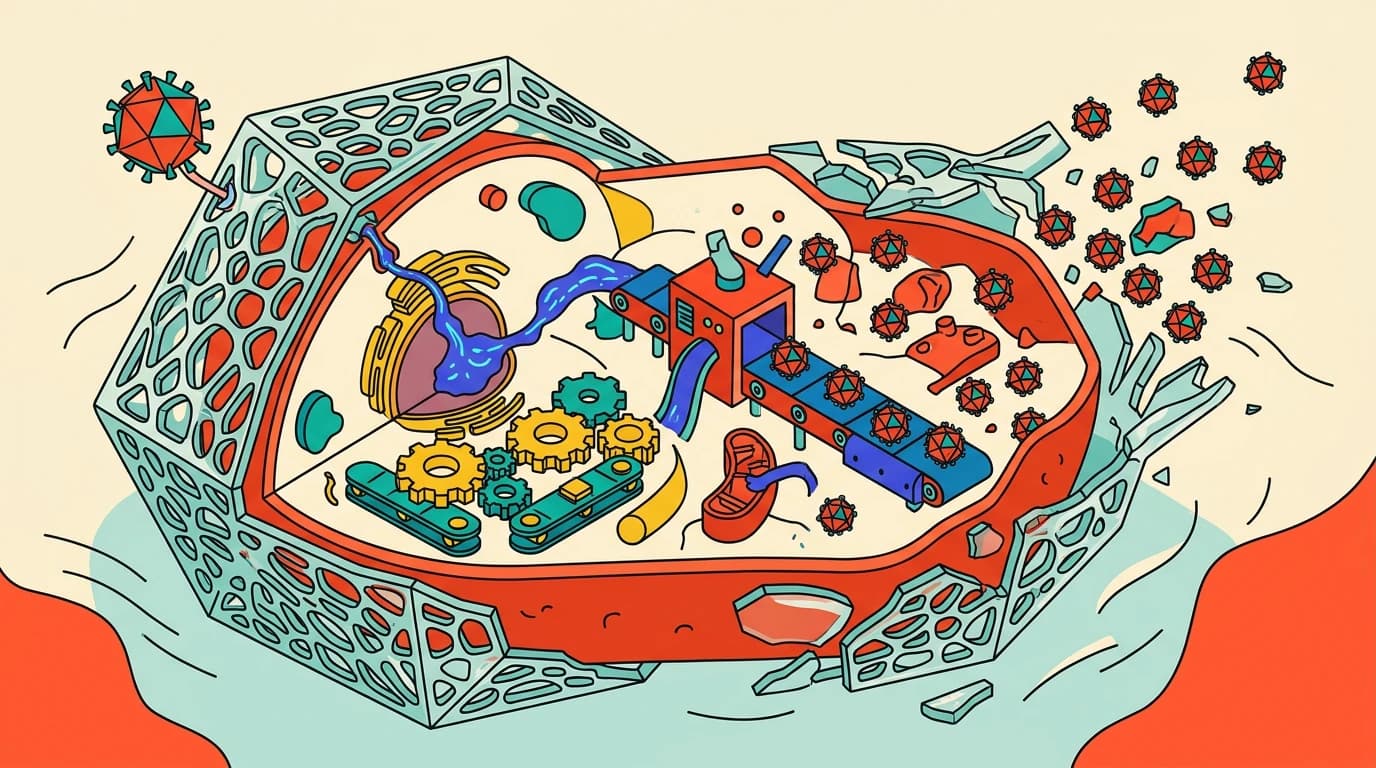
A microscopic takeover in the ocean
More than a third of a tiny ocean alga's genes change activity before a virus bursts it open.
The victim is Chaetoceros tenuissimus, a diatom—a type of microscopic marine algae that helps drive Earth's carbon cycle. When a marine diatom virus infects this single-celled organism, it does not just destroy it. It rewires the cell's internal chemistry first.
Tracking a cell's changing chemistry
To see how this happens, scientists ran a lab study on infected Chaetoceros tenuissimus cells. They used transcriptomics, which tracks which genes are turned on or off, alongside lipidomics, the large-scale study of fats and oils inside a cell.
Think of the virus like a hacker taking over a factory's control room. It shuts down normal production and redirects raw materials—such as sulphur, nitrogen, and fats—to build new viral parts before the factory is destroyed. Of course, a virus has no brain or plan; this takeover is driven purely by chemistry.
A staged metabolic shift
The measurements showed a clear, step-by-step sequence before host lysis, the moment the cell bursts open and dies. Early on, the diatom shifted its sulphur and fat metabolism and boosted nitrogen assimilation—how it turns inorganic nitrogen into building blocks for growth.
The cells also built up specific fats, including phosphatidylethanolamine, ceramide, and triacylglycerol, and changed their fatty acid mix. Late in the infection, stress and cell-death genes switched on.
Understanding this resource partitioning—how a cell divides its energy and nutrients—matters because diatoms and RNA viruses are both abundant in the ocean.
What we still don't know
This study only looked at one diatom species in a lab, not natural ocean blooms. It also did not measure how these cellular changes affect ocean carbon export or wider marine ecosystems. Whether other diatoms react the same way remains an open question.
Science words
- Diatom
- A widespread type of microscopic marine algae that plays a major role in ocean primary production and the global carbon cycle.
- Transcriptomics
- The study of all the RNA molecules in a cell to see which genes are being turned on or off.
- Lipidomics
- The large-scale study of the types and amounts of fats and oils inside a cell.
- Host lysis
- The bursting or breaking open of a host cell, which kills the cell and releases new viruses.
- Nitrogen assimilation
- The process by which organisms take up inorganic nitrogen and convert it into molecules needed for growth.
- Resource partitioning
- How a cell divides and allocates its available energy and nutrients among different biological processes.
Check it yourself
This story is based on a real research paper in New Phytologist by Kranzler, Lowenstein, Bamshid et al. We write with AI help and check it against the paper, but the original is the final word.