How a circular RNA acts as a molecular decoy to drive pancreatic cancer
A loop of non-coding RNA directly docks onto DNA and hijacks a key enzyme brake, switching on hundreds of genes that fuel pancreatic cancer.
Reading level
The full story with proper science words explained.
A loop that breaks the rules
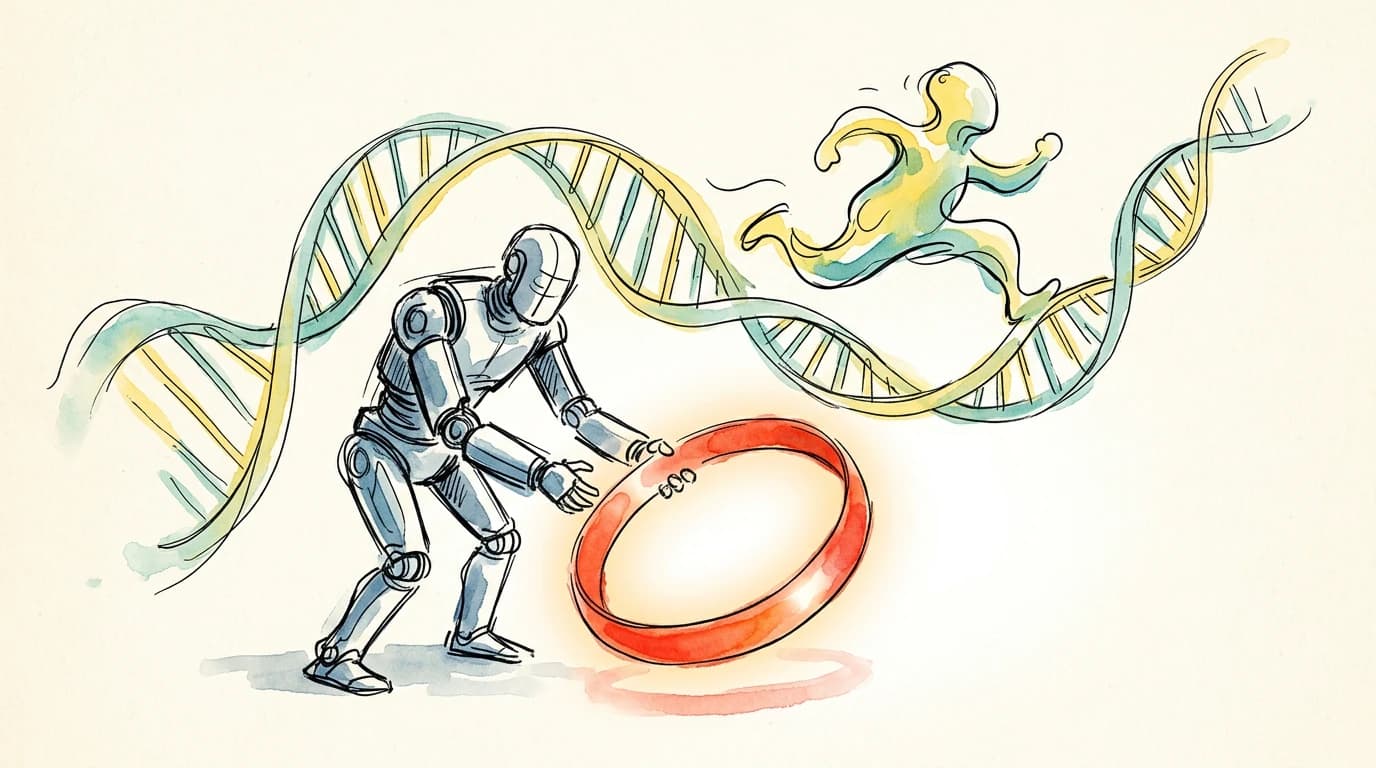
Pancreatic cancer has an overall survival rate of just 13%. It remains notoriously hard to treat, largely because its cells are skilled at switching on growth pathways and dodging chemotherapy. Scientists studying pancreatic ductal adenocarcinoma noticed high levels of an unusual loop of genetic material called circFOXK2. It belongs to a group known as circular RNA, which does not code for proteins and forms continuous closed loops rather than open strands. Most researchers assumed circular RNA cancer roles mainly involved soaking up other small molecules, acting like a chemical sponge. However, circFOXK2 is doing something much more direct.
The decoy pocket
The team discovered that circFOXK2 physically anchors itself across the genome by matching sequences on the cell's DNA. It contacts 7,400 genes, directly altering the output of 300 target genes. Binding was distributed across gene bodies (45.1%), intergenic regions between genes (50.2%), and promoters (3.7%).
To see what happens at these sites, the team used three-dimensional computer modelling. They found that circFOXK2 folds into a specific structural pocket that binds directly to a protein called PPIE. Think of circFOXK2 as a decoy wallet dropped in front of a security guard: it distracts PPIE and pulls it away from its normal partner, an enzyme called MLL1. Normally, PPIE acts like a brake on MLL1. With PPIE lured away into the RNA pocket, MLL1 is freed to do its job unimpeded. MLL1 adds chemical flags called H3K4me to histones, the spools that hold DNA. This chemical change loosens the spool, propping the DNA open so the copying machinery can read it rapidly.
Tumours, mice, and drug resistance
By keeping chromatin open, circFOXK2 drives the production of tumour-promoting proteins like TRIO and LAMA4. When the researchers tested 84 pairs of human pancreatic tumours and neighbouring healthy tissue from a single hospital, circFOXK2 levels closely tracked both H3K4me3 marks and these harmful target proteins.
Next, the researchers knocked down circFOXK2 in cell lines and in mouse xenografts (groups of seven). Without circFOXK2, active H3K4me histone marks dropped, tumour growth slowed, and the cells became more sensitive to gemcitabine, a standard chemotherapy drug.
Importantly, the authors note this work does not suggest that RNA sponging never happens. Instead, because circular RNA exists at relatively low numbers inside cells compared to microRNAs, this direct decoy mechanism is likely the primary way circFOXK2 operates here.
What we still don't know
While the findings identify a clear mechanism, big questions remain. The genome-wide binding experiments relied mainly on a single cell line, PANC-1, and the patient samples came from only one hospital centre. We also do not fully understand what triggers cells to produce circFOXK2 in the first place, beyond hints involving the transcription factors MYC and FOS. Most importantly, researchers do not yet know whether drugs can safely block the circFOXK2 pocket in living patients without harmful side effects.
Science words
- circRNA
- A closed loop of RNA that does not have free ends and typically does not make proteins.
- PPIE
- A protein that naturally binds to and restrains the enzyme MLL1.
- MLL1
- An enzyme that adds activating chemical tags to histone proteins.
- H3K4me
- A chemical mark on histone proteins that opens up DNA packaging so genes can be read.
Check it yourself
This story is based on a real research paper in Advanced Science by Wong, Peña‐Paladines, Leung et al. We write with AI help and check it against the paper, but the original is the final word.