How a 3D-printed soft robotic stroke glove copies human hands from afar
Engineers created a 159-gram soft robotic glove that flexes using air pressure to mimic a therapist's hand movements captured by a standard camera.
Reading level
The full story with proper science words explained.
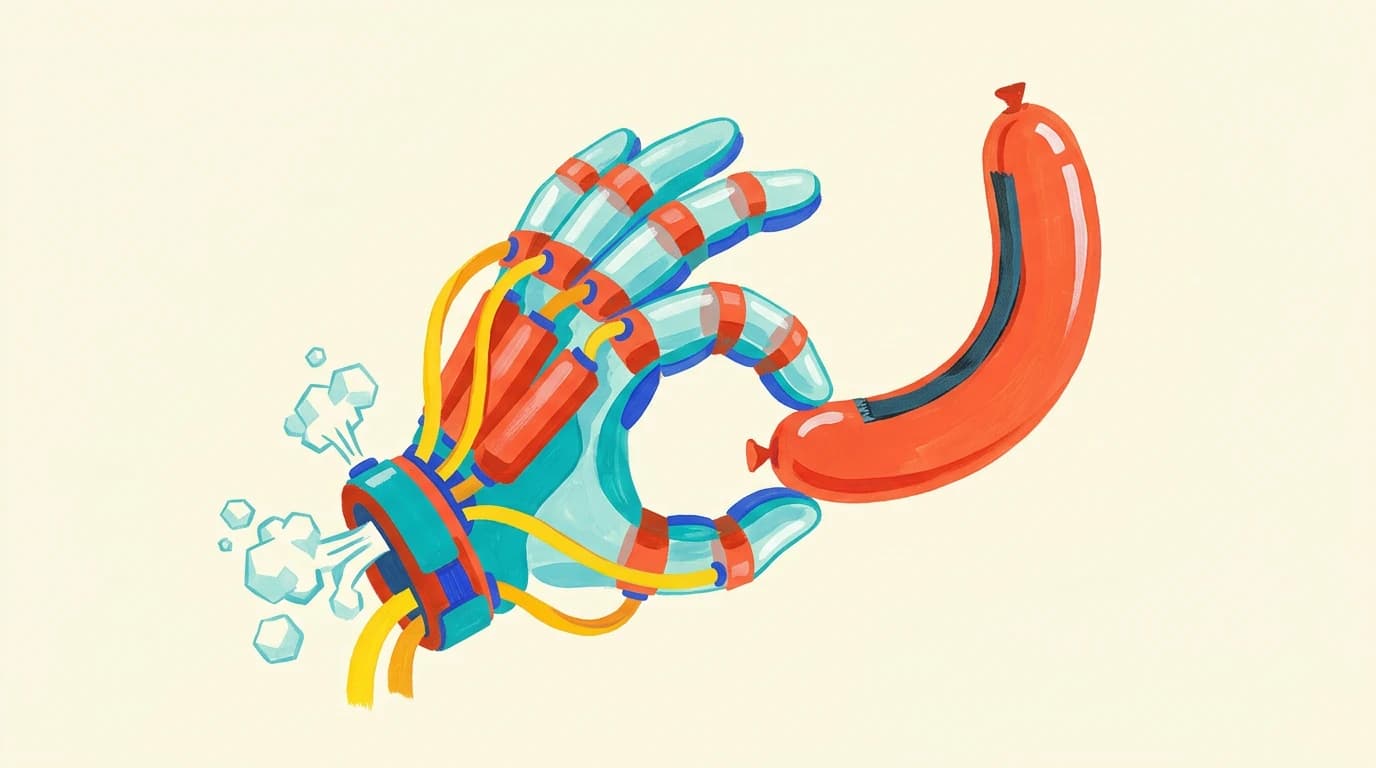
Pumping air into flexible fingers
Hold your hand flat, then curl it slowly into a tight fist. Your fingers fold across three distinct knuckles with zero effort. Following a stroke, however, everyday arm and hand movement can become a massive uphill battle. Physical therapy helps retrain the brain, but clinics are often overwhelmed, costly, and difficult to reach. What if a wearable device could guide those stiff joints from home, steered remotely by a webcam?
To tackle this challenge, researchers created a lightweight robotic stroke glove using single-material 3D printing. Traditional mechanical exoskeletons rely on rigid metal hinges and heavy motors. Instead, this wearable design uses flexible chambers printed from thermoplastic polyurethane, a bendy, rubber-like plastic. When inflated with compressed air, these hollow channels expand and force the artificial fingers to curl naturally.
Think of it like sticking a strip of non-stretching tape along one side of a long party balloon. If you blow into the balloon, the bare rubber expands easily while the taped edge stays put, forcing the whole tube to curl around itself. In this glove, the top walls balloon outward while the stiffer base stays rigid, generating a smooth gripping motion without a single metal joint. The analogy stops working once you consider real hands, because unlike an evenly bending balloon, human fingers bend sharply only at specific joints.
Simulating strength and motion
The system pairs a patient's wearable device with markerless camera tracking on the therapist's side. As a therapist makes a hand sign on video, a computer-vision interface maps the gesture in real time. A pneumatic compressor then feeds air pressure into the glove's actuators, mirroring the therapist's motion instantly. This approach avoids expensive, fragile data gloves packed with hard-to-clean sensors.
Building an effective design required careful computer simulations. Engineers used finite element modelling to monitor strain and prevent bulging under pressure. Early virtual models stretched dangerously under 100 kilopascals (kPa) of pressure, but design tweaks lowered the equivalent elastic strain from 42.2% down to 32.8%. The final physical prototype weighs just 159 grams, which is lighter than an average smartphone and well below the 500-gram design limit for comfortable wear.
Mechanical tests confirmed the glove packs plenty of curling ability. Across the knuckle joints of a single finger, the chambers produced a cumulative bending angle of 369.68 degrees at only 65 kPa. For everyday tasks like lifting a cup, a finger needs to push with at least 5 newtons of blocked force—the pushing strength exerted against an unmoving barrier. Under 100 kPa of pressure, the glove reached 13.05 newtons at the knuckle and 17.06 newtons at the fingertip.
What we still don't know
While the mechanical results are promising, the glove is not yet ready for immediate medical use. It was evaluated on seven healthy participants to test gesture recognition, imitation speed, and repeatability, rather than stroke patients recovering from hand impairments. Clinical validation is still required to confirm whether it aids real therapeutic recovery.
Material durability remains an open question during long, repetitive treatment cycles. The elastic strain in the printed plastic still sat above the 25% target, meaning pressure must stay strictly capped at 100 kPa using safety valves to avoid ruptures. Furthermore, it remains unknown how well the glove handles severe joint stiffness or muscle tightness in real patients.
Science words
- Thermoplastic polyurethane
- A flexible, rubber-like plastic that can be melted and shaped using a 3D printer.
- Finite element modelling
- A computer simulation method that breaks an object into tiny sections to predict how it reacts to forces and pressure.
- Elastic strain
- The temporary stretching or deformation of a material when subjected to physical stress.
- Blocked force
- The mechanical pushing force an actuator exerts directly against an unmoving barrier.
- Pneumatic
- Powered or operated by compressed air.
Check it yourself
This story is based on a real research paper in iScience by Tawk, Saab, Abdallah et al. We write with AI help and check it against the paper, but the original is the final word.