Chemistry & Material Science26 February 2026
Generative AI Redefines the Design Limits of Lattice Metamaterials
Source PublicationScientific Publication
Primary AuthorsHu Z, Tao Q, Ding J, Qu S, Ye H, Chua JW, Niu T, Li R, Ma WWS, Mo H, Liu H, Zhai W, Li X, Song X.
These results were observed under controlled laboratory conditions, so real-world performance may differ.
The Engineering Challenge of Lattice Metamaterials
Modern engineering demands materials that are incredibly light but perform multiple physical functions simultaneously. Historically, engineers relied on a mathematical method called topology optimisation to work backwards from a desired function to a physical design, iteratively removing material from a defined block to save weight.
However, this older method has severe limitations. It tends to get stuck in narrow design parameters, failing to explore the full range of possible shapes and internal structures. As a result, engineers frequently miss out on highly efficient structural patterns.
A Generative AI Approach
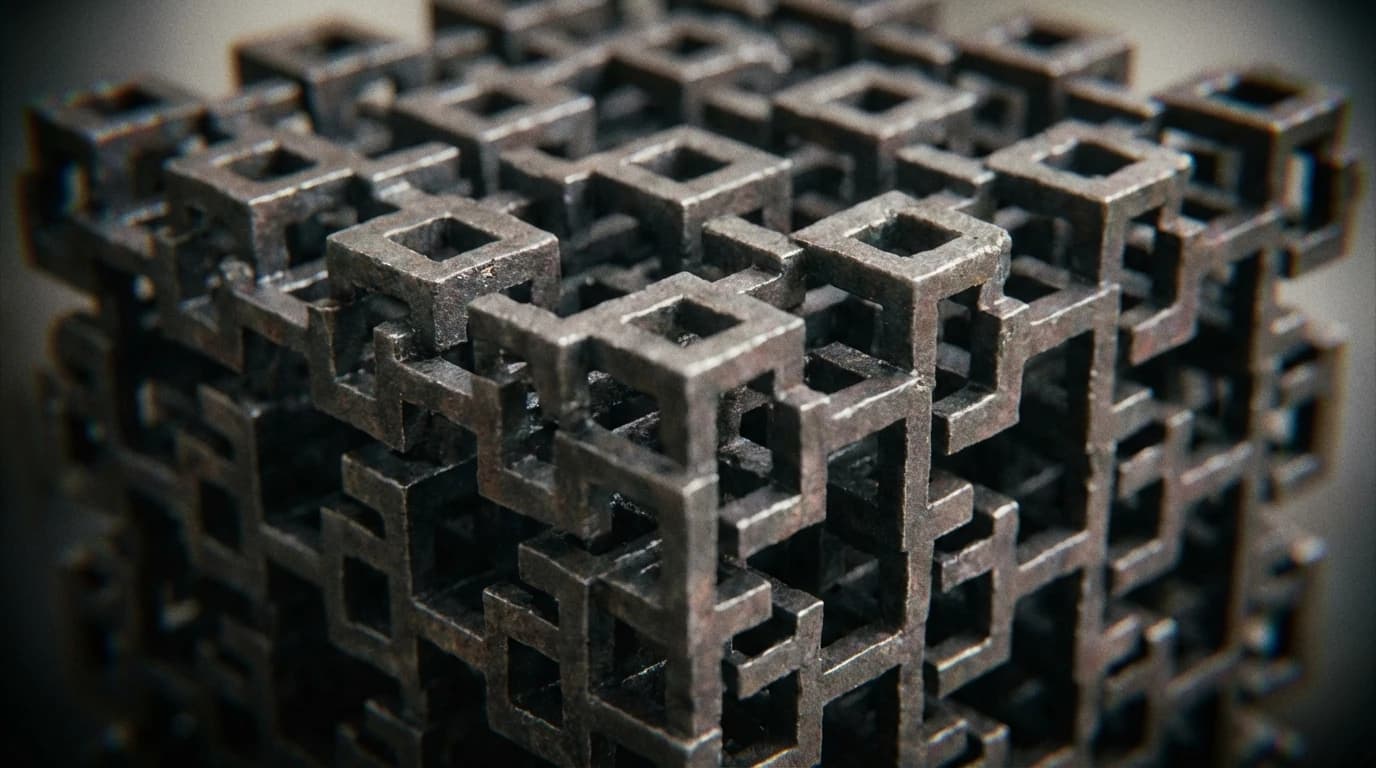
To bypass these older constraints, researchers built a hybrid artificial intelligence framework. They combined a 3D convolutional neural network with a generative adversarial network to create designs from the bottom up at the voxel level. Voxels act as three-dimensional pixels, giving the algorithm granular control over every microscopic cubic unit of the material.
Instead of modifying a pre-existing shape, the AI generates entirely new geometries based on physical performance targets. The team also applied a genetic algorithm to fine-tune these intricate shapes for broadband sound absorption. The researchers then 3D-printed these designs using stainless steel and tested them in the lab. The empirical data showed their AI-generated structures achieved:
- Between 40% and 200% greater energy absorption than standard shell lattices.
- An average sound absorption coefficient of approximately 0.7.
- Broadband acoustic performance across the 1000 to 5800 Hz frequency range.
Current Limitations and Unknowns
Despite the impressive laboratory metrics, it is vital to recognise that these findings represent a proof-of-concept experimental lab study. The framework currently relies on high-precision 3D printing of stainless steel at a specific bench scale, meaning the empirical validation is strictly confined to these controlled prototype conditions.
While the deep learning model successfully predicts energy absorption for these specific geometries, further empirical testing is necessary to determine how this voxel-level generation scales to broader industrial applications beyond the initial laboratory parameters.
Future Implications for Manufacturing
The findings suggest that voxel-level AI generation could eventually replace traditional topology optimisation in complex multifunctional engineering. By allowing algorithms to dictate form based strictly on physical targets, designers may discover structural efficiencies previously ignored by human intuition.
While the transition from the laboratory to widespread manufacturing will require broader validation across different material types and scales, this methodology provides a clear mathematical foundation for the next generation of multifunctional materials.
Cite this Article (Harvard Style)
Hu Z, Tao Q, Ding J, Qu S, Ye H, Chua JW, Niu T, Li R, Ma WWS, Mo H, Liu H, Zhai W, Li X, Song X. (2026). 'A Bottom-Up Design Framework for Multifunctional Lattice Metamaterials. '. Scientific Publication. Available at: https://doi.org/10.1002/advs.202518923