From Burnt Toast to Self-healing Elastomers: A Sweet Solution to Plastic Waste
Source PublicationMaterials Horizons
Primary AuthorsLi, Lok, Ngo et al.
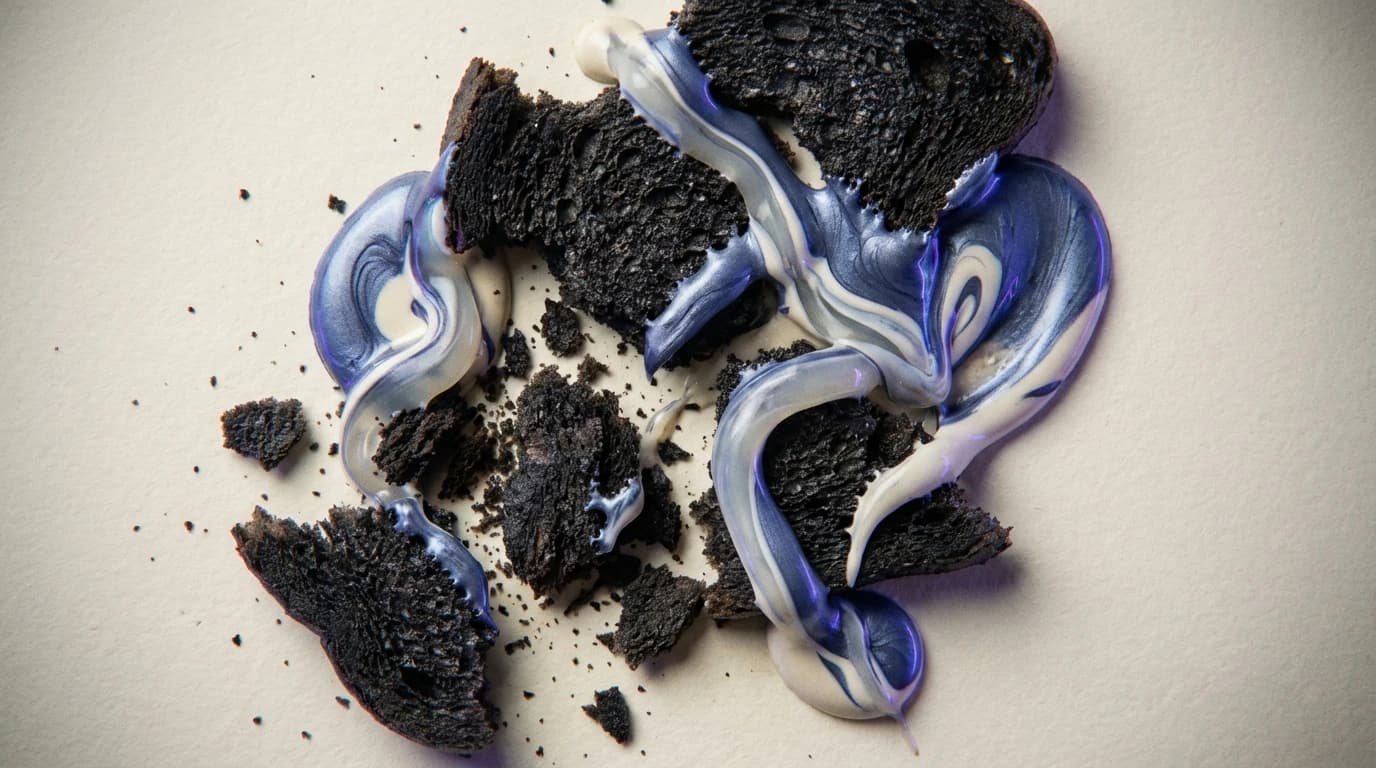
Have you ever watched a slice of bread turn golden in a toaster? You are witnessing the Maillard reaction. It is the chemical interaction between amino acids and reducing sugars that gives browned food its distinctive flavour. Usually, this is the domain of chefs. Now, chemists have borrowed the concept to solve a vexing problem in material science: how to make strong plastics that do not last forever.
The trouble with durable rubber is often its permanence. To make a polymer strong, we create crosslinks—chemical bridges that tie molecular chains together. Once formed, they rarely let go. This makes recycling a nightmare. The new study proposes a workaround that is surprisingly simple. By using maltose (a sugar) as both an initiator and a functional side group, researchers initiated a reaction with acrylamide in water. No harsh catalysts required. Just heat.
The mechanics of self-healing elastomers
The resulting material is technically an adaptively functionalised supramolecular network (AFSN). In plain English? It is a molecular lattice held together by hydrogen bonds and dynamic imine linkages. These connections are strong enough to withstand significant force, yet flexible enough to shift and repair.
The lab data is striking. The material demonstrated a tensile strength of up to 5 MPa and could stretch to 1000% of its original length. When cut, the dynamic linkages allowed the material to repair itself at room temperature. It is tough. It is sticky. But the real intrigue lies in its destruction.
Most crosslinked polymers require harsh chemicals to break down. This elastomer requires only water. The study reports that the supramolecular network dissolves completely in aqueous solution, allowing the material to be recovered and reprocessed without losing its mechanical integrity. While current industrial plastics rely on irreversible bonds, this research suggests that the future of sustainable materials might be found in reversible, water-mediated chemistry. It implies a closed loop where the end of a product’s life is simply a warm bath away from a new beginning.