Did We Just Hear the Edge of a Black Hole? Gravitational Waves Reveal Frame Dragging
Source PublicationNature
Primary AuthorsLu, Ma, Piccinni et al.
"It is like hearing the exact pitch of a spinning top's hum to figure out how fast the tabletop it is spinning on is dragging the tablecloth with it."
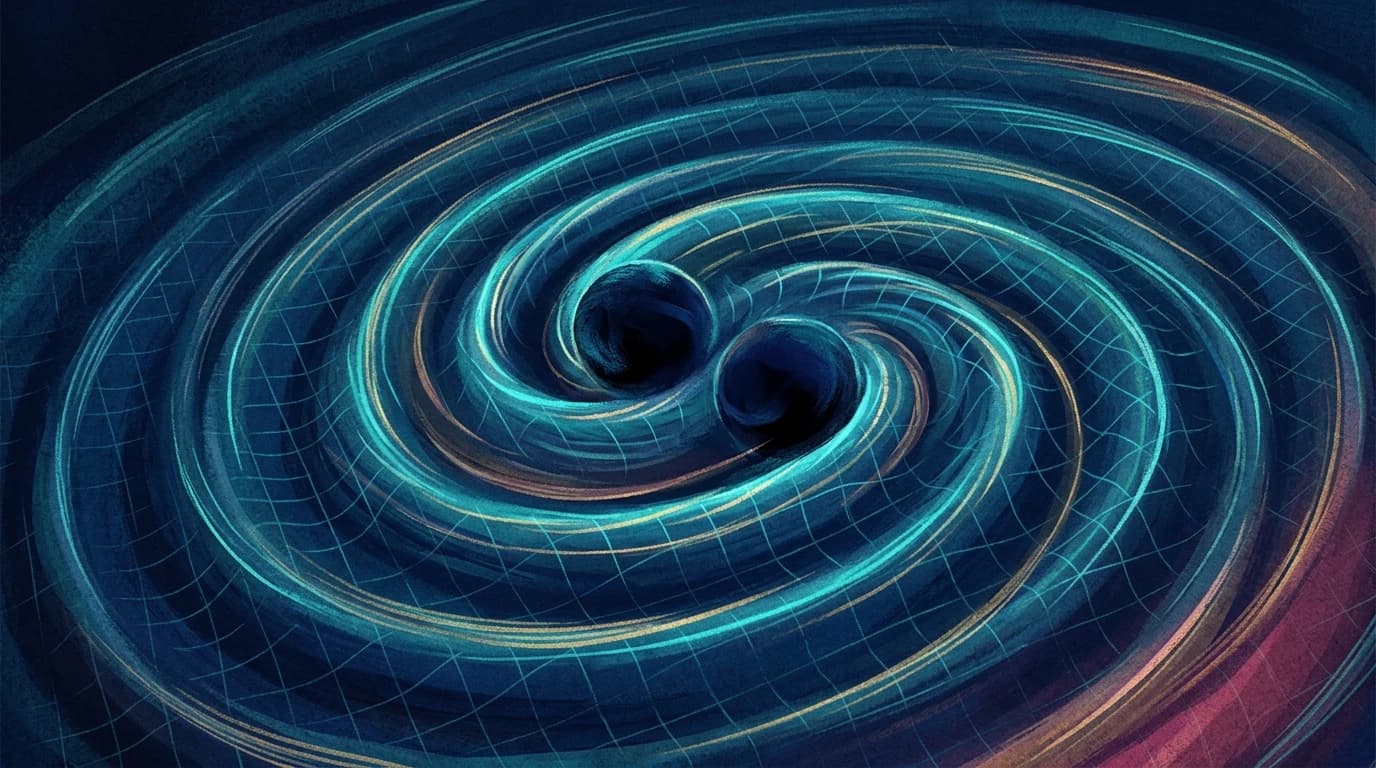
Did you know that space itself can get dragged around like sticky treacle? If you fell towards a spinning black hole, you would be forced to orbit it even if you turned your rocket engines on full blast.
This cosmic drag-along is called frame dragging, a mind-bending effect predicted by Albert Einstein. Until now, observing this extreme behaviour right at the "point of no return"—the event horizon—seemed nearly impossible.
But physicists just detected something wild. By analysing gravitational waves from a massive collision (event GW250114) using the LIGO detectors, researchers found a specific signal component called a "direct wave". This wave carries the direct imprint of the newborn black hole's horizon.
The signal wobbled at exactly twice the horizon's rotation frequency, showing space being dragged. It also decayed at a rate set by the black hole's surface gravity. This matches the theoretical physics of a spinning black hole perfectly.
Proving Einstein Right with Gravitational Waves
This measurement suggests we can now study the physics of the extreme "ergosphere"—the region just outside the event horizon. Instead of just guessing what happens at the edge of a black hole, scientists can now use these signals to directly measure the warped spacetime. This opens a new window to test our understanding of gravity where it is at its strongest.