Customising the Enemy: How Entamoeba histolytica genome editing Helps Us Fight a Deadly Parasite
Source PublicationopenRxiv
Primary AuthorsHuang, Suleiman, Luder et al.
"Like customising a video game character's stats to find their weaknesses, scientists are editing the parasite's DNA to understand how it attacks."
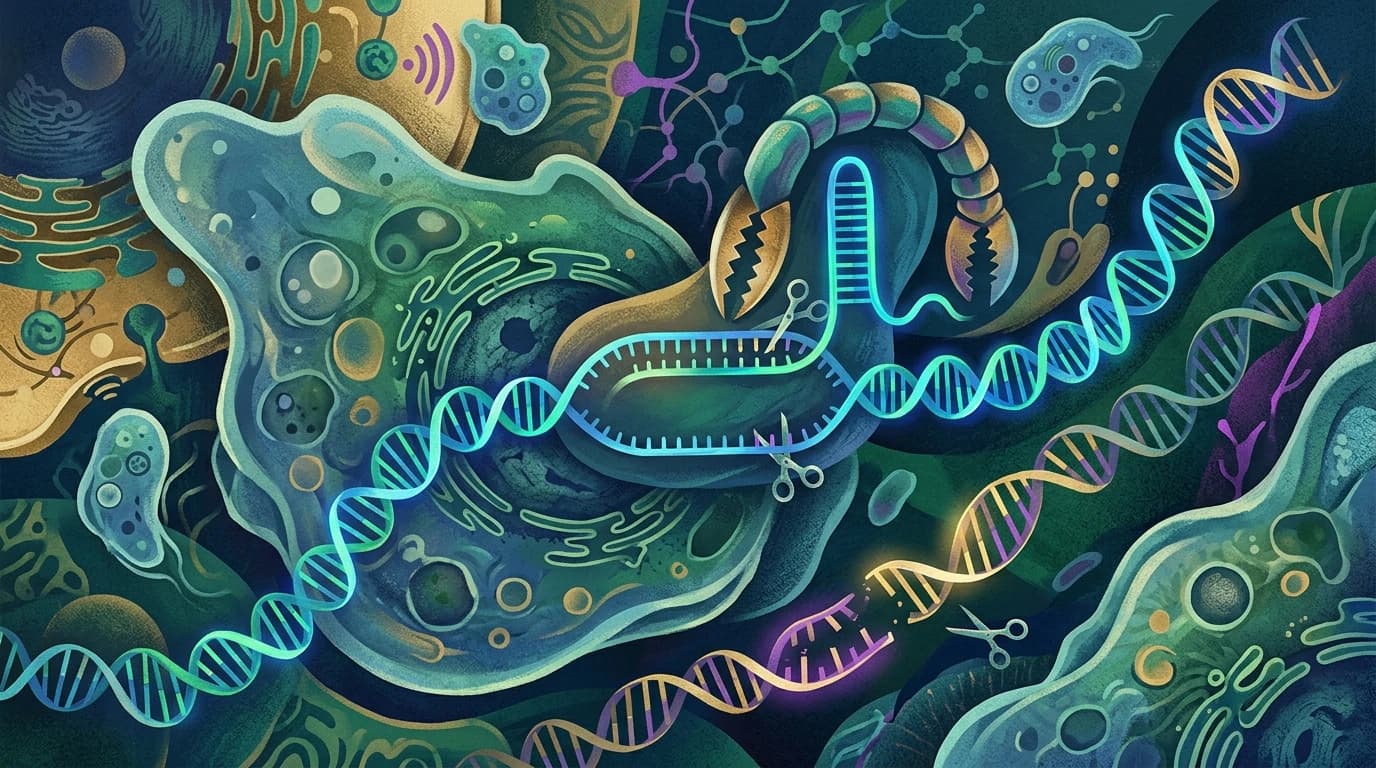
Imagine playing a video game where you cannot customise your character's gear or change their stats. You are stuck with a buggy, default build, trying to figure out how the boss operates. For decades, biologists faced this exact frustration when studying Entamoeba histolytica, a microscopic parasite that causes severe, life-threatening diarrhoeal disease in humans.
This single-celled invader is highly lethal, yet we know very little about its basic biology. Its complex DNA made it nearly impossible to edit, meaning scientists could not switch off individual genes to study their functions.
Entamoeba histolytica genome editing
To solve this, researchers adapted CRISPR/Cas9 tools to edit the parasite's native DNA. They targeted the cysteine protease 5 (CP5) gene, which is a known virulence factor the amoeba uses to attack human tissues.
To achieve this, the team developed several new molecular tools:
- Tested various nuclear localisation signals to guide the CRISPR machinery to the cell's centre.
- Used a viral skip peptide approach to improve gene delivery.
- Engineered custom promoters to precisely control gene expression levels.
This study measures the first successful modification of the parasite's actual genome. While these tools do not cure the infection immediately, they suggest a clearer path to identifying vulnerabilities. In the future, this molecular toolkit could help researchers design targeted treatments to block the parasite's ability to cause harm, protecting vulnerable communities worldwide.