Breaking the Nanoscale Bottleneck: The Future of 2D Quantum Sensing
Source PublicationScience Advances
Primary AuthorsKonrad, Kianinia, Spencer et al.
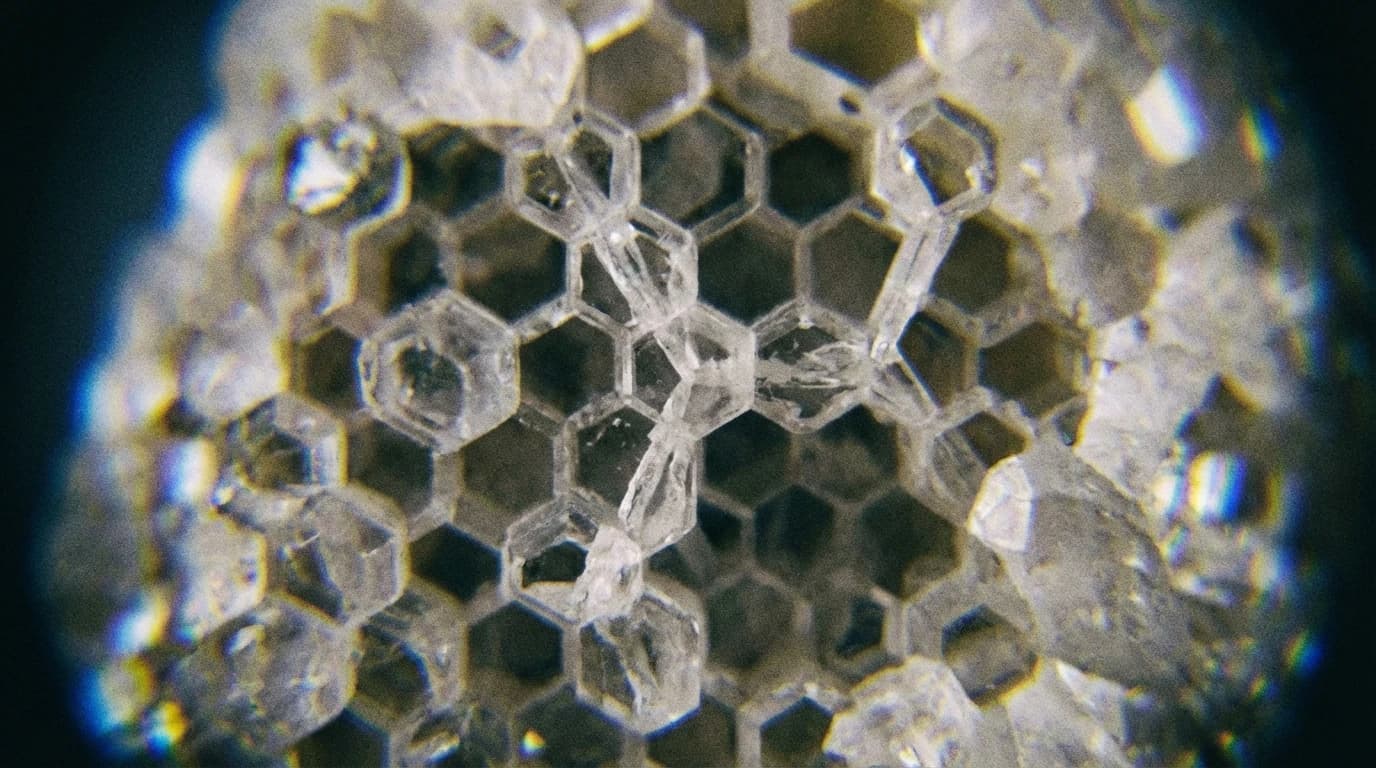
Current limitations in nanoscale measurement restrict our ability to map magnetic and electric fields at the atomic level. A new laboratory study directly addresses this bottleneck, offering a precise method to track energy relaxation in ultra-thin materials. This advance pushes the boundaries of 2D quantum sensing, helping transition these concepts from theoretical physics toward future practical engineering.
These results were observed under controlled laboratory conditions, so real-world performance may differ.
Scientists have long looked at hexagonal boron nitride as a highly promising material for quantum technologies. It contains tiny optical defects—specifically missing boron atoms—that can act as atomic-scale sensors. However, the way these defects absorb and release energy has remained largely hypothetical until now.
Researchers lacked the precise measurements of how electrons relax back to their ground state after being excited by light. Specifically, an intermediate 'shelving' state created a blind spot in the data. Without knowing the timings of these nonradiative relaxation paths, it was impossible to operate these sensors at maximum efficiency.
In a recent lab study, researchers directly measured this missing variable across a broad temperature range. They found that the relaxation time from the intermediate state to the ground state takes approximately 24.0 nanoseconds (with a narrow margin of error of 0.3 nanoseconds) at room temperature. Interestingly, the researchers measured that this duration roughly doubles when the material is cooled to low temperatures.
Armed with these measurements, the team ran simulations to observe how spin populations and ground-state polarisation evolve. They then used this data to optimise optically detected magnetic resonance pulse sequences. In a laboratory setting, this significantly improved how efficiently they could manipulate the material's spin, drastically increasing the sensor's overall sensitivity.
The Future Trajectory of 2D Quantum Sensing
This timing measurement suggests a clear path forward for the foundational development of quantum hardware. By optimising the sensitivity of these devices, engineers could eventually integrate them into highly sensitive, room-temperature diagnostic tools. Because 2D quantum sensing relies on atomic-thin materials, these sensors can sit incredibly close to target samples without disturbing them.
While still in the laboratory phase, this capability may eventually redefine how we measure the microscopic world. We can expect future practical applications to explore areas such as:
- Fundamental material science: Analysing novel materials at the atomic level to understand their intrinsic magnetic properties.
- Nanoscale diagnostics: Mapping minute magnetic and electrical signals with unprecedented proximity and minimal interference.
- Advanced quantum control: Developing more efficient spin manipulation techniques for next-generation quantum technologies.
Because this study provides the precise optical pulse sequences needed for optimal control, hardware developers no longer have to rely on guesswork for this specific material. The research removes a major technical hurdle, suggesting that scalable, high-sensitivity quantum sensors are moving closer to reality. As researchers continue to refine these atomic defects, the ability to measure the previously invisible will likely become a foundational tool in advanced material design.