Brane cosmology: Does the universe remember its past lives?
Source PublicationScientific Publication
Primary AuthorsAli
"Imagine formatting your computer hard drive. All your folders, photos, and files (the physical stars and galaxies) are completely erased. However, the fundamental operating system code (the quantum phase) remains intact, ready to boot up a brand new desktop."
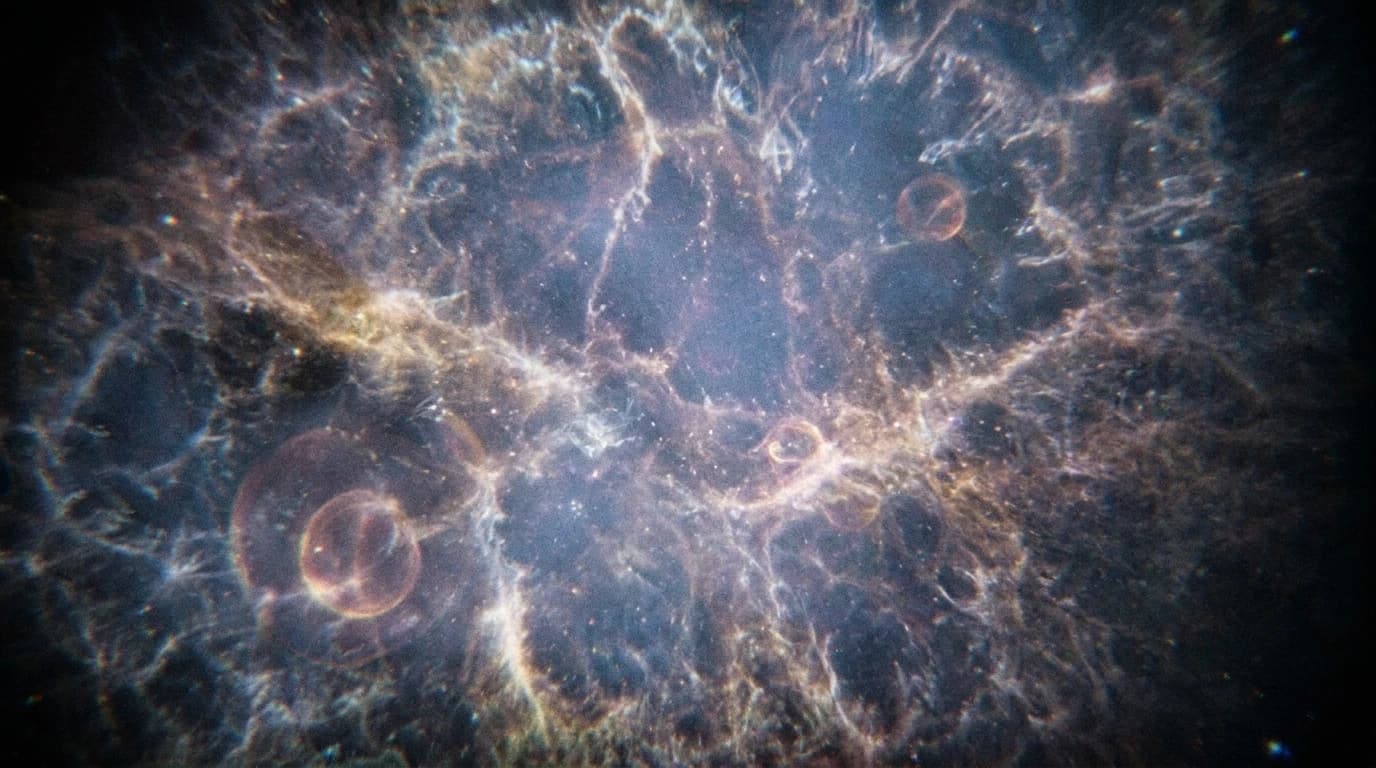
Is there anything quite as elegant as the sheer chaos of biology? When a caterpillar dissolves into genetic soup within its chrysalis, it somehow retains the biological memory to emerge as a butterfly. We often marvel at how evolution organises a genome to survive such extreme, structural destruction. It hides the most vital instructions deep within a resilient code. But what if the universe itself behaves in exactly the same way?
Instead of a biological genome, theoretical physicists study the mathematical rules of reality. They recently modelled what happens when a universe collapses entirely and bounces back. This brings us to a rather strange, beautiful concept.
What is Brane cosmology?
To understand this cosmic bounce, we have to look at Brane cosmology. This theory suggests our four-dimensional universe is just a flat 'brane' (short for membrane) floating inside a much larger, five-dimensional space. It is a bit like a single sheet of paper floating in a large room.
Researchers calculated how this brane behaves when it shrinks down to an infinitely small point before exploding outwards again in a new Big Bang. They wanted to know if any information survives this ultimate crunch. Can a universe remember its past life?
Think about why nature uses a highly compressed, protected genetic code. It allows life to reboot even after catastrophic mass extinctions. The researchers suggest the cosmos might use a similar strategy to survive its own death.
During a cosmic bounce, everything physical is destroyed. Space and time as we know them cease to exist. Classical features, like the cosmic microwave background or ancient gravitational waves, are completely erased. The physical 'body' of the universe is gone. The geometric structure that holds everything together simply melts away.
However, the study calculated that the 'quantum phase' of the universe—a sort of cosmic DNA—passes right through the bounce. This wave function evolves without breaking down. It carries the deepest, pre-geometric memory of the universe forward into the next cycle. The physical traits are lost, but the underlying quantum code remains untouched.
Looking for the cosmic fingerprint
While the physical slate is wiped clean, the mathematics suggests this quantum memory leaves a very faint echo. The researchers modelled that this surviving information could appear as specific entangled patterns in the background radiation of our current universe.
This is purely theoretical modelling, of course. We cannot yet point a telescope at these quantum memories. Yet, it suggests that our universe might not be a single, solitary event. Instead, it may be the latest generation in an endless cycle of cosmic evolution, forever carrying the hidden genetic code of its ancestors.