Brain-Like Chips: How Neuromorphic Computing Will Power Future AI
Source PublicationSmall
Primary AuthorsLee, Seo, Jeong et al.
"Traditional computers operate like a city where workers must commute long distances between homes and factories, whereas ACTANS turns each building into a live-work studio that eliminates the commute entirely."
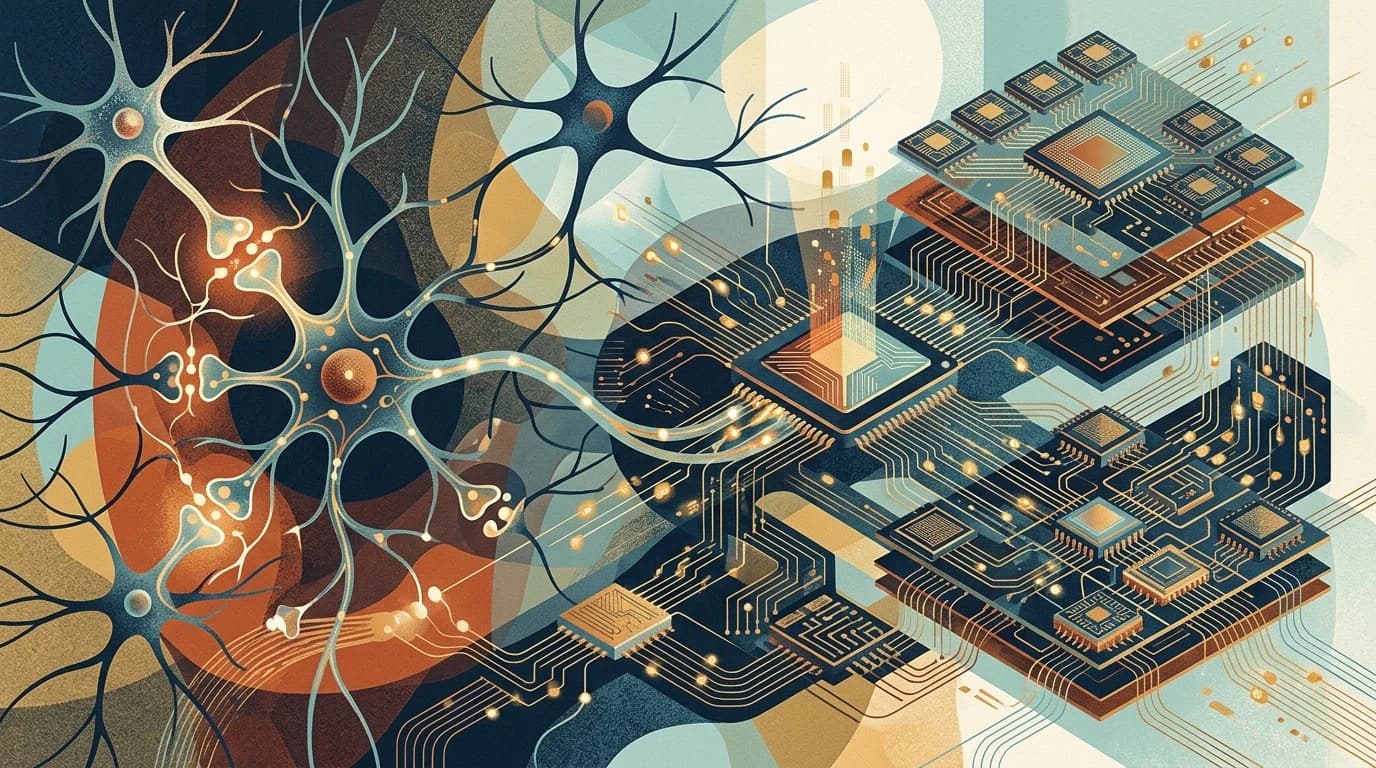
Imagine an autonomous drone navigating remote disaster zones using lightweight, highly efficient onboard intelligence. This future depends on neuromorphic computing, a method of designing computer hardware to emulate human brain structures.
These results were observed under controlled laboratory conditions, so real-world performance may differ.
Modern artificial intelligence relies on massive data centres that consume vast amounts of electricity. Conventional chips separate memory from processing, forcing data to travel constantly between two points and wasting energy.
Advances in Neuromorphic Computing Hardware
Engineers developed the Array of Cointegrated Transistor-Based Artificial Neurons and Synapses (ACTANS). This architecture uses structurally identical transistors to function as both neurons and synapses on standard silicon manufacturing lines. In a small-scale laboratory proof of concept, researchers built a single-neuron, sixteen-synapse array that successfully executed basic letter and pattern recognition tasks.
Future Careers in Brain-Inspired Tech
By integrating neurons and synapses directly into existing chip manufacturing processes, this design suggests that future handheld devices and robotics could run AI models locally with far less power.
As bio-inspired systems progress from bench prototypes toward real-world applications, exploring computer science, chip design, or neurobiology today could position you to help shape the energy-efficient technologies of tomorrow.