Atomic Betrayal: How **spin-lattice coupling** rewrites the rules of symmetry
Source PublicationPhysical Chemistry Chemical Physics
Primary AuthorsBhatia, Ahmad, Zeeshan et al.
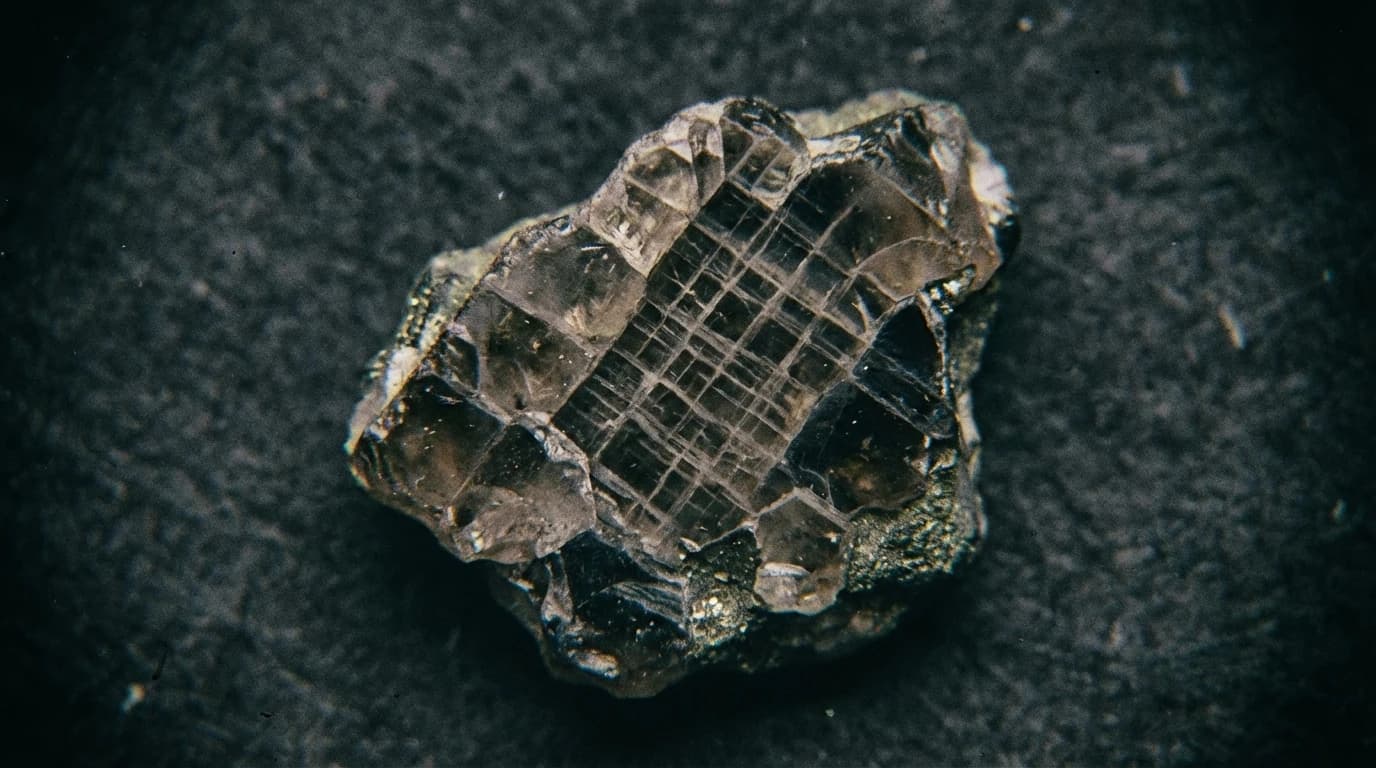
The crystal sits in the dark. It is a speck of potassium iridium bromide, nominally a perfect cube. To the human eye, it is inert. Dead matter. But down in the angstroms, a rebellion is underway. The structure is not the stoic foundation it appears to be. It is nervous. As the heat bleeds away, the atoms begin to panic. They cannot hold their formation. The perfect cubic cage rattles, distorting into something twisted, something less symmetrical. This structural instability is the antagonist of our story. It introduces chaos where we crave order. It muddies the waters. For years, this internal shifting has obscured the true relationship between the material's shape and its magnetic soul. The lattice vibrations create a noise that drowns out the subtle whispers of quantum alignment. It is a hidden saboteur, warping the environment before the magnetism even has a chance to set its stage.
To catch this saboteur in the act, scientists turned to the precision of light and resonance. By employing temperature-dependent Raman spectroscopy and Electron Paramagnetic Resonance (EPR), they managed to peer inside the chaotic transformation. They tracked the material as it cooled past 170 K and then 122 K. At these specific thresholds, the crystal structure snaps. It shifts from a cube to a tetragon, and finally to a monoclinic form. The instruments picked up the signals: anomalous broadening of phonon linewidths and shifts in resonance fields.
The plot twist of **spin-lattice coupling**
The data delivered a surprise. One might expect the magnetism to be a separate affair, arriving only when the material freezes at extremely low temperatures (the Néel temperature). However, the evidence suggests otherwise. The structural distortions are not merely background scenery; they are the directors of the play. The study indicates that the physical warping of the IrBr6 octahedra directly forces the magnetic spins to adapt.
This dynamic interaction occurs well above the magnetic ordering temperature. The lattice moves, and the spins have no choice but to follow. The findings demonstrate that symmetry-lowering distortions renormalize the vibrational modes. Consequently, the material exhibits static correlations mediated by spin-orbit entanglement long before it becomes magnetically ordered. By controlling the chemical pressure or the ligand fields, engineers might one day dictate these responses, turning a chaotic structural failure into a precise tool for future quantum devices.