A dirt-dwelling virus could help defeat tough bacteria
Scientists isolated a novel bacteriophage called APU1 from Bangladeshi dairy farm soil. The virus completely bursts resilient Bacillus bacteria without carrying unwanted toxins or antibiotic resistance genes.
Reading level
The full story with proper science words explained.
Hunting in farm dirt
Up to 97% of Earth's viruses live tucked away in soil and sediment. Yet dirt makes up less than 2% of cataloged viral DNA. This vast collection of soil viruses, called the virome, remains mostly uncharted territory. To explore this hidden corner, a science team dug up earth from a dairy farm in Bangladesh. They wanted to find a virus that could attack tough Bacillus microbes.
These microbes pose serious problems. They spoil food, cause human illness, and form armored coats that withstand boiling heat, strong radiation, and harsh cleaning chemicals. Finding new ways to stop them matters because typical treatments often fail against such hardy targets.
Meet phage APU1
The team mixed the dairy dirt with a broth of live host microbes. Soon, they caught a new bacteriophage—a type of virus that infects and kills bacteria. They named it APU1. When placed on laboratory plates seeded with host cells, the virus carved out clear, round holes where it wiped out the microbes.
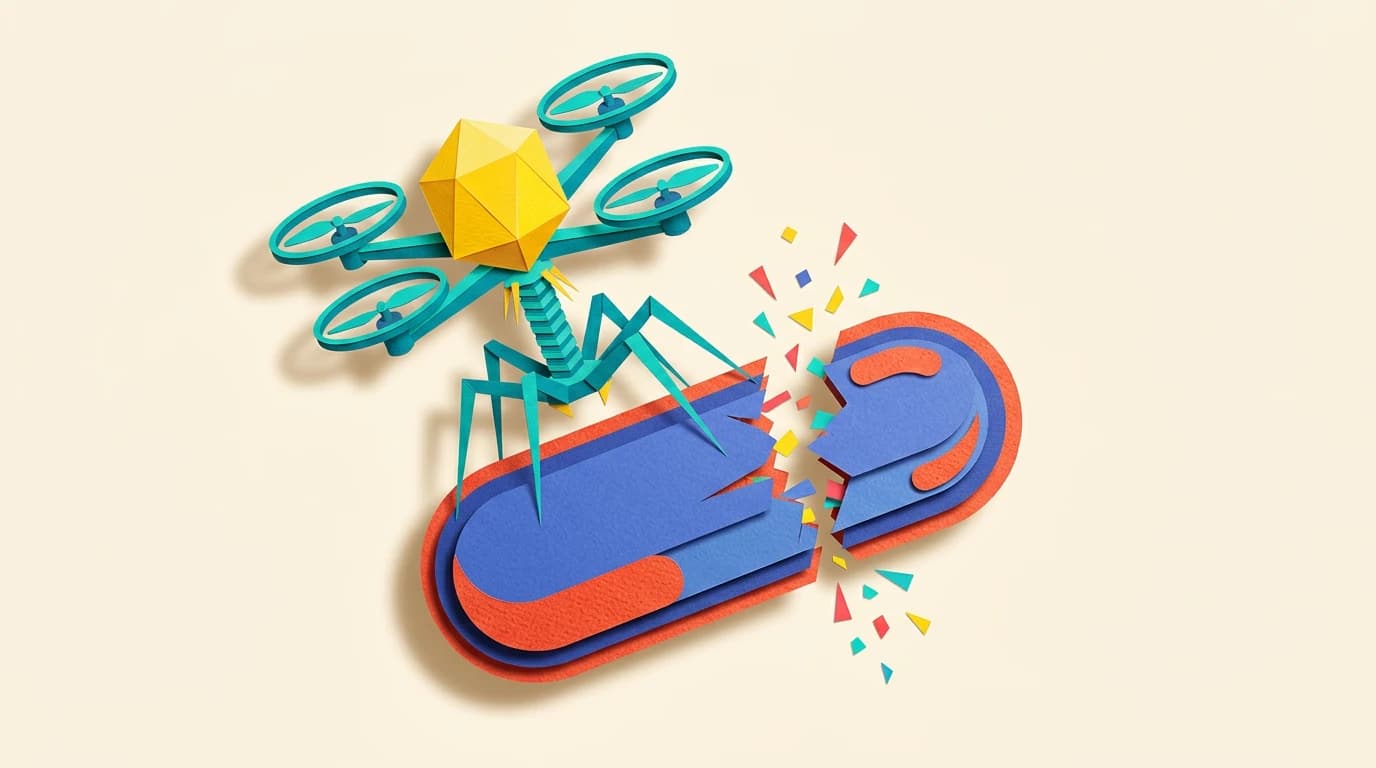
It killed its host using the lytic cycle, an infection path where a virus copies itself inside a cell and then splits the host wide open. Think of APU1 as a precision drone. Unlike broad medicine that wipes out all surrounding cells like a blast, this virus targets only matching microbes. Unlike a real drone, it cannot steer; it simply floats until it bumps into the right host by luck.
Reading the viral map
Next, the team extracted the viral DNA and ran it through an Illumina MiSeq sequencing machine. The result showed a long double-stranded string made of 153,847 base pairs. Software tools proved this code was 99.91% complete with zero dirt contamination.
Inside this code, the team spotted 236 coding sequences, which are DNA strips that give instructions to build proteins. They also found five transfer RNAs, which assist in assembling those proteins. To find where APU1 fits on the family tree, they tested its Average Nucleotide Identity, an index that checks how closely two genomes match. APU1 matched its nearest known relatives by only 89.75%. Since naming rules call for a 95% match to share a species tag, APU1 is an entirely new species.
The study also verified that APU1 carries no genes for dangerous poisons or drug resistance. It also lacks the genes needed to hide quietly inside a host. It only lives to copy itself and break open its victim.
What we still do not know
The team only tested APU1 on one Bacillus host strain grown in their lab. Because several related microbes share a near-identical 16S ribosomal gene, the exact species of this host remains unconfirmed. We do not yet know how many other strains or disease-causing variants APU1 can destroy.
The authors also did not capture electron microscope photos of the virus, leaving the physical shape of its head and tail hidden. They skipped tests measuring its heat tolerance, acid stability, and exact growth speeds. Finally, the roles of 51 mystery proteins in its genome remain unsolved questions for future work.
Science words
- Virome
- The entire collection of viruses found in a specific environment or organism.
- Bacteriophage
- A specialized virus that infects and reproduces inside bacteria.
- Lytic cycle
- An infection pathway where a virus copies itself inside a cell and then bursts it open.
- Coding sequence
- A segment of DNA containing instructions to assemble a specific protein.
- Average Nucleotide Identity
- A measurement of DNA similarity used to tell whether two organisms belong to the same species.
Check it yourself
This story is based on a real research paper in Environmental Microbiology Reports by Haider, Esha, Rahman et al. We write with AI help and check it against the paper, but the original is the final word.